
Software development team structure matters more than many companies realize.
A serious software product is not built by simply adding more developers. It is built by covering the right responsibilities at the right time: product decisions, architecture, design, backend development, frontend or mobile development, testing, infrastructure, project coordination, and long-term technical ownership.
Some projects need a small focused team. Others need a broader structure with specialized roles. The right setup depends on product stage, complexity, budget, delivery expectations, and how much risk the system carries.
The goal is not to make the team as large as possible.
The goal is to create a software development team structure that gives every important part of the product a clear owner.
What is software development team structure?
Software development team structure is the way responsibilities are organized across the people building and maintaining a software product.
It answers questions like:
- Who defines what should be built?
- Who owns the technical architecture?
- Who designs the user experience?
- Who builds the backend?
- Who builds the frontend or mobile apps?
- Who tests the product?
- Who manages deployments and infrastructure?
- Who coordinates delivery and communication?
- Who makes sure the system remains maintainable over time?
When these responsibilities are clear, the team can move faster with less confusion.
When they are unclear, even talented developers can struggle because decisions are delayed, scope changes are chaotic, bugs repeat, and no one knows who owns the final outcome.
Why team structure affects software delivery
Software projects usually fail because of more than code.
They fail because requirements are unclear, architecture is weak, priorities change without structure, testing is skipped, infrastructure is treated as an afterthought, or communication breaks down between business and engineering.
A good team structure reduces those risks.
It does not guarantee success, but it creates the conditions for better decisions, clearer delivery, and more predictable progress.
Good structure creates ownership
Every important area of a product needs ownership.
If nobody owns product priorities, the team may build the wrong features.
If nobody owns architecture, the system may become difficult to scale or maintain.
If nobody owns testing, releases become risky.
If nobody owns infrastructure, deployment becomes fragile.
If nobody owns communication, clients and stakeholders lose visibility.
A strong software development team structure makes ownership visible.
Good structure reduces rework
Rework is one of the most expensive problems in software development.
It happens when features are built before requirements are clear, when design does not match user workflows, when backend structure cannot support the product, or when integrations are underestimated.
The right team structure helps catch these problems earlier.
That is especially important in complex products where every wrong assumption can affect multiple parts of the system.
Good structure improves communication
Communication should not depend on everyone talking to everyone all the time.
That does not scale.
A structured team has clear communication paths: product questions go to product ownership, technical decisions go through technical leadership, delivery status is handled through project management, and implementation details stay close to the engineers doing the work.
This keeps communication direct without becoming chaotic.
The core roles in a software development team
Not every project needs every role as a separate full-time person.
In smaller teams, one person may cover multiple responsibilities. In larger projects, the same responsibilities may require dedicated specialists.
What matters is that the responsibilities are covered.
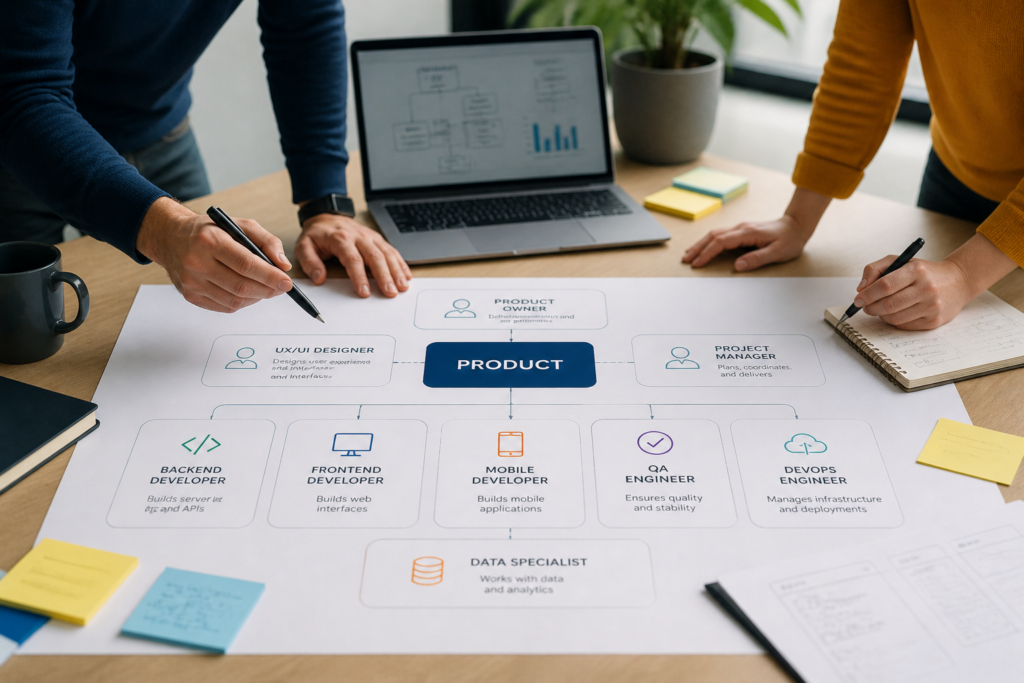
1. Product owner or product lead
The product owner or product lead is responsible for product direction.
This role connects business goals, user needs, priorities, and delivery decisions.
In early-stage projects, this may be the founder, CEO, internal product manager, or client-side stakeholder. In mature products, it may be a dedicated product manager or product owner.
The product lead helps answer:
- What problem are we solving?
- Who are we building for?
- Which features matter first?
- What should wait?
- How do we measure whether the product is working?
Without this role, development teams often receive unclear requests and are forced to make business decisions without enough context.
The official Scrum Guide defines the Product Owner as one of the accountabilities inside a Scrum Team, alongside Developers and the Scrum Master. Whether or not a company follows Scrum strictly, the need for clear product ownership still applies.
2. Technical lead or software architect
The technical lead or software architect is responsible for the technical direction of the system.
This role is especially important when the product involves complex backend logic, multiple applications, integrations, data processing, mobile apps, infrastructure, AI features, or long-term scaling expectations.
The technical lead helps decide:
- which architecture fits the product
- how the backend should be structured
- how data should be modeled
- which technologies are appropriate
- how services should communicate
- where technical risks exist
- how to avoid unnecessary complexity
This role protects the product from short-term decisions that create long-term problems.
For serious products, technical leadership should be involved early — not only after development has already gone wrong.
3. UX/UI designer or product designer
Design is not only about how the product looks.
Good product design clarifies how the product works.
A UX/UI designer helps define user flows, screen structure, information hierarchy, interaction patterns, and the practical experience of using the product.
This matters because many development problems are actually product definition problems.
If workflows are unclear in design, they usually become more expensive during development.
Design is especially important for:
- SaaS dashboards
- mobile apps
- admin panels
- customer portals
- marketplaces
- operational platforms
- products with multiple user roles
A strong design phase can reduce development waste because it makes workflows visible before engineering time is spent.
4. Backend developer
Backend developers build the server-side logic that powers the product.
This includes APIs, databases, authentication, permissions, business rules, integrations, background jobs, reporting, notifications, and data processing.
Backend development is often underestimated because users do not always see it directly.
But in serious software products, the backend is usually where much of the complexity lives.
Backend developers are especially important for:
- SaaS platforms
- CRM and business systems
- marketplaces
- AI-enabled features
- data platforms
- payment systems
- IoT workflows
- external API integrations
If the backend is poorly structured, the product may become difficult to scale, maintain, or extend.
5. Frontend developer
Frontend developers build the user-facing web application.
They turn designs and product requirements into working interfaces that users interact with in the browser.
Frontend development includes interface structure, state management, API integration, form behavior, responsiveness, accessibility considerations, and performance.
In modern products, frontend development can be highly complex.
A SaaS dashboard, analytics platform, CRM system, or operational web app may require significant frontend architecture, not just simple page building.
6. Mobile developer
If the product includes mobile apps, mobile developers become a core part of the team.
Mobile development can include native iOS, native Android, or cross-platform development depending on the product needs.
Mobile apps add specific responsibilities:
- device compatibility
- app store release process
- push notifications
- offline behavior
- local storage
- camera, GPS, maps, or device APIs
- beta distribution and testing
For some products, a web MVP is enough. For others, mobile is central to the user experience.
We covered this decision in more detail in our article on mobile apps vs websites.
7. QA engineer or testing owner
Testing needs ownership.
That does not always mean a dedicated QA engineer from day one, but it does mean someone must be responsible for checking whether the product works as expected.
Testing may include:
- manual testing
- regression testing
- cross-browser testing
- mobile device testing
- API testing
- payment testing
- release validation
- bug verification
When testing is treated as optional, bugs reach users more often and releases become stressful.
For live systems, QA is not just a quality concern. It is a business risk control.
8. DevOps or infrastructure engineer
DevOps and infrastructure work keeps the product running reliably.
This role may cover cloud infrastructure, deployment pipelines, environments, monitoring, backups, containerization, server configuration, security basics, and performance support.
In smaller projects, backend developers may handle basic deployment. But as the product grows, infrastructure needs clearer ownership.
This is especially important for:
- production SaaS platforms
- systems with real users and payments
- products with multiple environments
- systems with background workers or queues
- platforms with high availability requirements
- legacy systems being modernized
Infrastructure becomes even more important during modernization projects. We covered that in our guide on modernizing legacy software.
9. Project manager or delivery manager
A project manager or delivery manager keeps the work organized.
This role helps translate scope into tasks, coordinate priorities, track progress, manage communication, organize releases, and make sure the team is not working blindly.
In technical projects, project management works best when it is technically informed.
A non-technical project manager can help with coordination, but complex software projects often need someone who understands enough about development to communicate clearly with both engineers and clients.
Good delivery management helps prevent:
- unclear priorities
- untracked decisions
- missed dependencies
- scope confusion
- communication gaps
- surprise delays
Small team structure for an early MVP
An MVP does not always need a large team.
In many cases, a focused small team is better than a large unfocused one.
A practical MVP team may include:
- product owner or founder
- technical lead
- UX/UI designer
- backend developer
- frontend or mobile developer
- QA/testing support
- project manager or delivery lead
Some of these may be part-time responsibilities. For example, a technical lead may also write backend code. A project manager may also support QA coordination. A designer may be heavily involved early and less involved later.
The important part is not headcount.
The important part is that the MVP has enough structure to avoid predictable mistakes.
We covered MVP planning and budget ranges in more detail in our guide on how much it costs to build an MVP.
Team structure for a serious SaaS or platform product
As a product becomes more serious, the team usually needs more specialization.
A SaaS platform, CRM, marketplace, operational platform, or mobile product with backend infrastructure may need:
- product owner or product manager
- technical lead or architect
- backend developers
- frontend developers
- mobile developers if mobile apps are part of the product
- QA engineer
- DevOps or infrastructure engineer
- project manager
- data or AI specialist if needed
The more complex the product becomes, the more important architecture and coordination become.
For example, AnthemCRM is a long-term CRM and SaaS platform involving backend systems, multiple frontend applications, marketing automation, analytics, AI-enabled features, integrations, microservices, and ongoing development.
A system like that cannot be managed as a simple “developer task list.” It needs architecture, backend ownership, frontend delivery, infrastructure, testing, product coordination, and long-term technical continuity.
Team structure for operational and data-heavy platforms
Operational platforms often need a different kind of team structure.
The product may involve business workflows, IoT inputs, data processing, integrations, dashboards, permissions, reporting, and multiple applications connected to one central platform.
In this kind of project, backend architecture and data modeling are especially important.
The team may need:
- technical architecture leadership
- backend engineers
- frontend engineers
- integration specialists
- cloud/infrastructure support
- QA/testing process
- product and delivery coordination
For example, Aiota is an operational data platform designed around IoT sources, external systems, business workflows, and real-world operational data.
That type of product needs more than feature development. It needs a team that can reason about architecture, data flow, integrations, infrastructure, and how the platform will evolve as new customer use cases appear.
Common software team structure mistakes
Many software projects struggle because the team structure is wrong for the product.
Mistake 1: Hiring only developers
Developers are essential, but development alone does not define a product.
If nobody owns product decisions, user workflows, architecture, testing, or delivery coordination, the developers will be forced to fill those gaps.
Sometimes that works for a while. But as complexity grows, the lack of structure becomes expensive.
Mistake 2: Adding more people too early
More people do not automatically mean faster delivery.
If the product direction is unclear, adding more developers can make the problem worse. More people need more communication, more task definition, more review, and more coordination.
Small, senior, focused teams often outperform larger teams with unclear ownership.
Mistake 3: No technical leadership
Without technical leadership, teams may make inconsistent decisions across the codebase.
One developer solves a problem one way, another solves it differently, and over time the system becomes harder to maintain.
Technical leadership creates consistency and protects the long-term structure of the product.
Mistake 4: Treating QA as something that happens at the end
Testing at the end is usually too late.
Quality needs to be part of the development process, not a final panic before release.
For serious products, testing should be planned, repeated, and connected to release decisions.
Mistake 5: Ignoring infrastructure until launch
Infrastructure decisions affect deployment, performance, monitoring, security, backups, and future scaling.
If infrastructure is ignored until the end, launch becomes riskier than necessary.
Even an MVP should have enough infrastructure planning to support real usage.
How software development team structure changes over time
The right team structure changes as the product matures.
Early idea stage
At the idea stage, the most important roles are product thinking, technical assessment, and design exploration.
The team may be very small.
The goal is to clarify the product before spending too much on development.
MVP stage
At the MVP stage, the team needs enough structure to build the first useful version.
The team should cover product ownership, design, backend, frontend or mobile, testing, infrastructure basics, and delivery coordination.
This does not require a large team, but it does require clear responsibility.
Growth stage
As the product grows, the team usually needs more specialization.
Backend, frontend, mobile, QA, DevOps, analytics, AI, and support workflows may become more defined.
This is where long-term architecture and delivery process become more important.
Scale stage
At scale, team structure may move beyond individual roles and into team types.
For example, Team Topologies describes patterns such as stream-aligned teams, platform teams, enabling teams, and complicated-subsystem teams. These patterns help larger organizations think about how teams interact and how responsibility should be organized as systems grow. You can read more in the Team Topologies key concepts.
Most early products do not need this level of structure.
But the principle is useful: as software grows, team design becomes part of system design.
Agile roles and real-world responsibilities
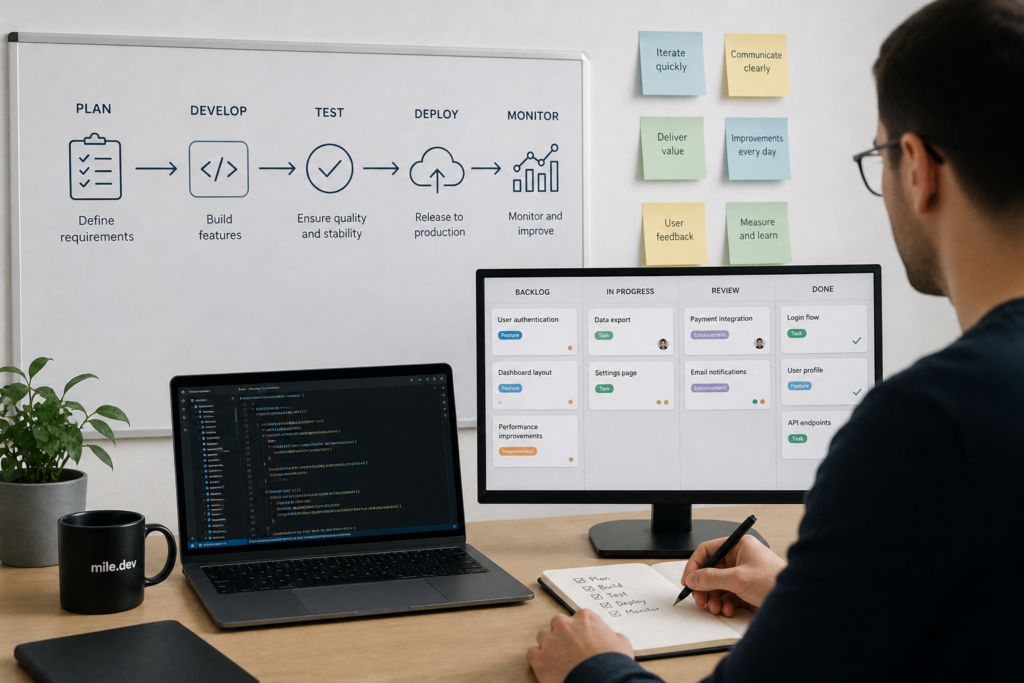
Many software teams use agile language, but the labels matter less than the responsibilities.
The Scrum framework defines three accountabilities inside the Scrum Team: Product Owner, Scrum Master, and Developers. Atlassian also provides a practical overview of Scrum roles and responsibilities.
But in real client projects, especially custom software projects, responsibilities may not map perfectly to textbook roles.
A technical project manager may cover some Scrum Master-style coordination. A founder may act as product owner. A senior backend engineer may also act as technical lead. A designer may help clarify product flows before development begins.
That is normal.
What matters is that the team is honest about who owns each responsibility.
Internal team, external partner, or hybrid structure?
Companies do not always need to hire every role internally.
Sometimes the strongest structure is hybrid: an internal product owner or business stakeholder works with an external development team that provides architecture, design, engineering, QA, DevOps, and delivery support.
This can work well when:
- the company has product knowledge but lacks engineering capacity
- the project needs to start faster than internal hiring allows
- the product requires several technical roles at once
- the company needs senior technical input early
- the system needs long-term development and maintenance
It does not work well if the external team behaves like a disconnected vendor.
For hybrid structures to work, communication, ownership, documentation, and delivery process must be clear.
We explored related considerations in our article on the advantages of outsourcing development.
How mile.dev structures software teams
At mile.dev, our team structure is built around serious engineering and long-term delivery.
Our core team includes full-time engineers across backend, frontend, mobile, infrastructure, DevOps, and technical project management, supported by carefully selected external collaborators when project load requires it.
This allows us to cover the key responsibilities needed for custom software projects without treating every engagement as a generic staffing exercise.
We are especially focused on:
- early technical assessment
- realistic estimation
- architecture-led planning
- clear delivery structure
- backend and infrastructure reliability
- mobile and frontend execution
- testing and release stability
- long-term maintainability
You can read more about the company and the team behind the work on our About page.
You can also explore our broader software development services, including web platforms, SaaS products, mobile applications, backend systems, AI integrations, infrastructure, migrations, refactoring, and long-term development.
So, what software development team structure do you need?
The right software development team structure depends on what you are building.
A small MVP may need a compact team with product, design, backend, frontend or mobile, QA, infrastructure basics, and delivery coordination covered.
A serious SaaS platform may need stronger technical leadership, dedicated backend and frontend roles, QA, DevOps, and ongoing product management.
An operational platform may need deeper backend architecture, data modeling, integrations, infrastructure, and long-term technical planning.
The important part is not copying a generic team chart.
The important part is understanding the responsibilities your product requires and making sure each one has a clear owner.
If you are planning a software product and want to understand what team structure, scope, and technical effort it may require, you can start with a free consultation. Send us your project details and we will review the scope before suggesting the next step.