
How much does it cost to build an MVP?
The honest answer is: it depends on what you mean by MVP.
A simple clickable prototype, a no-code validation tool, a small internal web app, a SaaS platform with payments, and a mobile product with backend infrastructure can all be described as an MVP — but they are not the same kind of project.
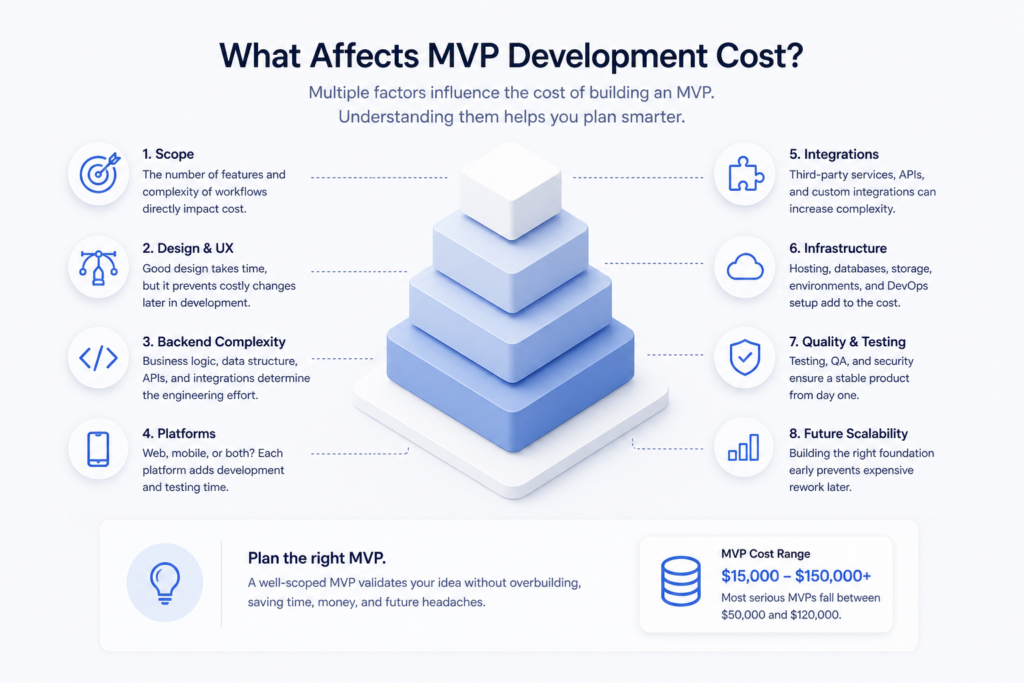
That is why MVP development costs can vary so much. In practical terms, MVP development can range from around $15,000 for a very small, tightly scoped version to $150,000+ for a more complex product with custom backend logic, integrations, mobile apps, AI features, or operational workflows.
For serious functional MVPs, a more realistic planning range is often somewhere between $50,000 and $120,000, depending on scope and technical complexity. As a recent mile.dev example, one MVP reached live production and user onboarding at roughly $80,000–$90,000, after which the client continued development with additional features and improvements.
The important question is not only “How much does an MVP cost?”
The better question is:
What is the smallest version of the product that can prove the core business idea without creating technical problems too early?
What an MVP actually means
MVP stands for Minimum Viable Product.
In theory, that means the smallest version of a product that can be used to validate a real business assumption with real users. The Lean Startup approach describes an MVP as a way to learn from customers with the least effort necessary, rather than building a complete product before testing whether the idea is right. You can read more in this overview of what an MVP is.
In practice, the term is often used too loosely. Some people use MVP to mean a landing page. Others mean a prototype. Others mean the first full version of a software platform.
This matters because the cost depends heavily on which version you are talking about.
A prototype is not the same as an MVP
A prototype is usually a visual or semi-functional representation of the product. It may be useful for investor discussions, early user testing, design validation, or internal decision-making.
A prototype does not usually need production-grade architecture, infrastructure, authentication, data storage, payments, security, or real operational workflows.
An MVP is different.
A functional MVP is software that real users can use. It usually needs enough backend, frontend, data structure, hosting, testing, and security to support actual usage.
That difference has a direct impact on cost.
Typical MVP cost ranges
There is no universal price for MVP development, but it helps to think in practical ranges.
A very small MVP can sometimes be built for $15,000–$30,000, but that usually means narrow scope, limited functionality, few integrations, and careful control over what is included.
A more realistic range for a serious functional MVP is often $50,000–$120,000. This is where the project usually includes real product design, frontend development, backend logic, database structure, testing, deployment, and enough stability for early users.
More complex MVPs can reach $150,000+ when they involve mobile apps, custom backend systems, external integrations, AI features, payment flows, operational workflows, real-time data, or infrastructure complexity.
These ranges are not fixed pricing. They are planning ranges. The actual cost depends on scope, technical risk, product clarity, and how much of the system needs to be production-ready from the first release.
Very simple validation version
A very simple validation version may cost relatively little if it is mainly used to test demand.
This could include:
- a landing page
- a waitlist
- a clickable design prototype
- a simple no-code workflow
- a basic proof-of-concept
This kind of early validation may cost far less than a real software MVP, especially if it is mostly a landing page, prototype, or no-code workflow. It can be useful before development, but it should not be confused with production software.
Simple functional MVP
A simple functional MVP may include a small number of core features, basic user accounts, a web interface, simple data storage, and limited backend logic.
This can be enough when the product has a narrow use case and does not require complex integrations, heavy automation, mobile apps, or advanced infrastructure.
Examples:
- a simple SaaS dashboard
- a small internal tool
- a basic marketplace proof-of-concept
- a simple booking or request platform
- a focused web app with one main workflow
For this kind of MVP, the cost is usually driven by how clear the scope is and how much production readiness is required.
Standard software MVP
A standard MVP is usually closer to what most serious founders and companies actually need.
It may include:
- custom product design
- frontend development
- backend development
- user roles and permissions
- database architecture
- admin tools
- third-party integrations
- payments or subscriptions
- cloud deployment
- testing and launch support
This is where MVP development starts to become a real software project, not just a validation experiment.
The cost is higher because the team is not only building screens. They are making technical decisions that affect how the product can evolve later.
Complex MVP
A complex MVP may involve multiple platforms, deeper backend logic, real-time features, external systems, AI, mobile apps, data pipelines, IoT workflows, reporting, analytics, or operational dashboards.
Examples:
- a SaaS platform with multiple user roles and billing
- a CRM or workflow automation platform
- a mobile product with backend services
- an operational data platform
- a system that integrates with multiple external APIs
- a product using AI features on real business data
In these cases, the MVP may still be “minimum” from a product perspective, but it is not simple from an engineering perspective.
Trying to force this kind of product into an unrealistically small budget usually creates technical debt, unstable releases, or a product that needs to be rebuilt soon after launch.
What affects the cost of building an MVP?
The cost of an MVP is not determined by one factor. It is usually the result of several technical and product decisions working together.
1. Product scope
Scope is the biggest cost driver.
Every feature adds design, development, testing, edge cases, and maintenance. Even features that look simple in the interface may require significant backend logic underneath.
For example, a “send notification” feature may involve user preferences, email delivery, templates, background jobs, error handling, tracking, and third-party services.
This is why the first step in MVP planning should be reducing the product to the smallest meaningful version.
Not the smallest possible version.
The smallest version that can still prove the main product assumption.
2. Design and user experience
Some MVPs can start with simple interface design. Others need more careful UX work from the beginning.
If the product has complex workflows, multiple user types, dashboards, forms, mobile screens, or operational processes, design becomes more important.
Good design is not just visual polish. It helps define how the product works.
Weak product design can make development slower because the team ends up discovering workflow problems during implementation instead of resolving them earlier.
3. Backend complexity
Backend development is often where MVP costs are underestimated.
The backend may need to handle:
- authentication
- user roles
- business logic
- data models
- API design
- admin tools
- background processing
- notifications
- reporting
- security
- integrations
If the backend is poorly structured in the MVP stage, the product may become hard to extend later.
For serious products, backend architecture should not be treated as an afterthought.
4. Web, mobile, or both
A web MVP is usually faster and simpler to launch than a mobile MVP.
Mobile apps add platform-specific complexity. Native iOS and Android development require additional testing, release management, store submissions, device compatibility work, and often more coordination with backend services.
That does not mean mobile should be avoided. If the product depends on location, push notifications, offline use, camera access, maps, or frequent user engagement, a mobile app may be the right choice.
But if the early goal is validation, a web version may sometimes be the more practical first step.
We explored this decision in more detail in our article on mobile apps vs websites.
5. Integrations
Integrations often make an MVP more expensive than expected.
Common integrations include:
- Stripe payments
- email providers
- SMS providers
- maps and location services
- CRMs
- accounting systems
- social platforms
- AI services
- analytics tools
- external APIs
Some integrations are simple. Others require complex error handling, rate limits, synchronization, data mapping, permissions, or approval processes.
The cost is not only in connecting the API. The cost is in making the integration reliable enough for real users.
6. Payments and subscriptions
If the MVP needs payments, subscriptions, invoices, coupons, trials, customer portals, tax handling, or plan changes, that also affects cost.
Payment systems are not only about adding a checkout button. A SaaS MVP may need billing logic, subscription states, failed payment handling, plan permissions, invoices, customer management, and webhook processing.
Stripe provides detailed billing documentation for these workflows, which shows why subscription features should be planned carefully even in an MVP.
7. AI features
AI can be useful in an MVP, but it should not be added only because it sounds modern.
AI features make sense when they support a real workflow, such as:
- summarizing data
- generating content
- classifying information
- helping users search or analyze data
- automating repetitive tasks
- responding to customer input
AI can also increase complexity because the product may need prompt design, data handling, review flows, usage limits, cost monitoring, fallback logic, and security considerations.
For an MVP, the best AI features are narrow, practical, and tied directly to product value.
8. Infrastructure and deployment
Even an MVP needs somewhere to run.
Infrastructure can include:
- hosting
- database setup
- storage
- deployment pipelines
- domain and DNS setup
- monitoring
- error tracking
- backups
- environment configuration
Not every MVP needs complex infrastructure, but it does need enough structure to be stable, secure, and maintainable.
This is especially important if real users, payments, private data, or business operations depend on the product.
Cloud costs are also not always obvious at the beginning. Tools like the AWS Pricing Calculator can help estimate infrastructure costs, but the architecture still needs to be planned correctly.
9. Testing and quality control
Testing is often ignored in early cost discussions, but it should not be.
An MVP does not need every enterprise-level testing process from day one, but it does need enough quality control to avoid obvious failures.
Testing may include:
- functional testing
- cross-browser testing
- mobile device testing
- API testing
- payment testing
- basic security checks
- deployment testing
If the MVP is unstable, users may reject the product for reasons unrelated to the business idea.
What should be included in an MVP budget?
When planning an MVP budget, it is useful to think beyond development hours alone.
A realistic MVP budget may include:
- scope analysis
- technical planning
- product design
- frontend development
- backend development
- database design
- third-party integrations
- cloud setup
- testing
- project management
- deployment
- post-launch fixes
If these are not included in the estimate, they do not disappear. They usually appear later as delays, bugs, confusion, or unexpected cost.
This is why estimation should be treated as an engineering responsibility, not a sales exercise.
Why cheap MVP estimates can become expensive
A low estimate is not always a bad thing. Sometimes the scope is genuinely small.
But a low estimate becomes dangerous when it is based on ignoring complexity.
Common reasons cheap MVPs become expensive later include:
- unclear scope
- weak architecture
- missing technical planning
- poor database structure
- rushed frontend implementation
- unreliable integrations
- no testing process
- no deployment strategy
- no room for product changes
The result is often a product that works just enough for a demo but not well enough for real usage.
That may be acceptable for a prototype. It is not acceptable for a real MVP that needs to support users, investors, operations, or revenue.
How to reduce MVP cost without damaging the product
Reducing MVP cost is not about cutting quality everywhere.
It is about cutting the right scope.
Start with the core workflow
Every MVP should have one main product question.
For example:
- Will users create an account and complete this workflow?
- Will businesses pay for this automation?
- Can this operational process be moved into software?
- Will users return to the app regularly?
- Can this data be collected and presented in a useful way?
The MVP should focus on proving that question.
Everything else should be challenged.
Reduce user roles
Multiple user roles increase complexity quickly.
If possible, start with the smallest number of roles needed to test the product.
Delay advanced reporting
Dashboards, analytics, filters, exports, and reports can be valuable, but they can also expand scope heavily.
For the MVP, include only the reporting that is needed for users to understand the core value.
Use integrations carefully
Integrations can create a lot of hidden cost.
Before adding an integration, ask whether it is essential for MVP validation or whether it can be added later.
Build web first when possible
If the product does not require mobile-specific functionality from day one, a web MVP may be the faster and more cost-effective first step.
A mobile app can be added later when the mobile use case is clearer.
Avoid overbuilding admin tools
Admin panels are important, but they can become larger than expected.
For an MVP, keep admin functionality practical and focused on what is needed to operate the product early.
What a serious MVP estimate should include
A useful MVP estimate should not be a single optimistic number.
It should explain what is included, what is not included, what assumptions were made, and where the main risks are.
A good estimate should include:
- feature breakdown
- development ranges
- technical assumptions
- design scope
- backend scope
- integration scope
- testing effort
- project management effort
- deployment requirements
- possible risks or unknowns
This gives the client a clearer understanding of what they are actually buying.
It also protects the project from starting under unrealistic expectations.
Example: MVP cost thinking for different product types
Different products require different levels of engineering effort.
SaaS MVP
A SaaS MVP usually needs user accounts, subscriptions or billing, dashboards, admin tools, backend logic, notifications, and cloud deployment.
If the SaaS product includes automation, reporting, AI features, or multiple user roles, the scope grows quickly.
For example, AnthemCRM is a long-term CRM and SaaS platform with marketing automation, analytics, AI features, microservices, and ongoing development. A platform like that is not just a simple MVP once it reaches production scale — but the early technical decisions still matter because they influence how the product can grow later.
Operational platform MVP
An operational platform MVP may involve business workflows, external systems, IoT inputs, dashboards, data collection, permissions, and reporting.
This type of MVP often requires more backend planning than a simple web app because the product needs to support real-world processes.
For example, Aiota involves operational data, IoT sources, business systems, integrations, and long-term platform architecture. Products like this need careful planning even at the MVP stage because the system may expand across many workflows and customer use cases.
Mobile app MVP
A mobile app MVP may require native iOS development, Android development, backend APIs, authentication, push notifications, maps, payments, offline storage, testing, and app store release management.
Mobile MVPs can be very effective when the product depends on frequent use or device features.
But they also require more planning than many founders expect.
Should you build an MVP or start with discovery?
If the product is clear, an MVP estimate may be possible after a structured technical review.
If the product is still vague, it may be better to start with discovery, product definition, or a technical planning phase.
This can help clarify:
- what should be built first
- which features are essential
- which features can wait
- what technical risks exist
- which platform should come first
- what budget range is realistic
Discovery can reduce waste because it prevents the team from estimating a product that is not defined well enough yet.
How mile.dev approaches MVP development
At mile.dev, we treat estimation as part of engineering.
Before development begins, we look at scope, architecture, integrations, workflows, technical complexity, and realistic delivery effort.
We do not believe in selling a fixed-price promise based on optimism. Software projects change as they become clearer. A useful estimate should create clarity, not hide uncertainty.
Our work usually fits companies that need more than a quick prototype. We are a better fit for products that require serious engineering: web platforms, SaaS products, mobile apps, backend systems, AI-enabled features, operational platforms, integrations, migrations, and long-term development.
You can see the broader scope of our work on our software development services page.
So, how much does it cost to build an MVP?
The cost to build an MVP depends on what the product needs to prove and how much engineering is required to prove it properly.
A simple validation version can be relatively small. A functional software MVP usually requires a more serious budget. A complex MVP with custom backend logic, integrations, mobile apps, AI, or operational workflows can require significantly more planning and development effort.
The safest approach is not to ask for the cheapest possible MVP.
The better approach is to define the smallest useful product that can validate the business idea while still being built on a technical foundation that can evolve.
If you are planning an MVP and want a realistic view of scope, technical complexity, and development effort, you can start with a free consultation. Send us your project details and we will review the scope before suggesting the next step.