
The advantages of outsourcing software development go well beyond reducing cost. That can still be one factor, but it is no longer the only reason companies choose to work with external development teams.
For many businesses, outsourcing is about accessing the engineering capability they need without building a full internal team before the product, budget, or technical direction is ready for it.
A good software development partner can help a company design, build, improve, and maintain software with more structure than a short-term contractor and more flexibility than hiring an entire in-house team at once.
The real value depends on the partner, the project, and the way the work is managed. Outsourcing can create clarity, speed, and technical depth when done properly. It can also create risk when expectations, ownership, and communication are unclear.
What outsourcing software development means
Outsourcing software development means working with an external team to design, build, improve, or maintain software instead of relying only on internal employees.
This can include many types of work:
- building a new web platform or SaaS product
- developing native or cross-platform mobile applications
- creating backend systems, APIs, and integrations
- modernizing an existing software product
- taking over unstable or legacy systems
- supporting cloud infrastructure and deployments
- adding AI, automation, search, or analytics features
- maintaining and improving a live product over time
In practice, outsourcing works best when the external team is not treated as a temporary coding resource, but as a structured engineering partner with responsibility for technical decisions, delivery quality, and long-term maintainability.
The main advantages of outsourcing software development
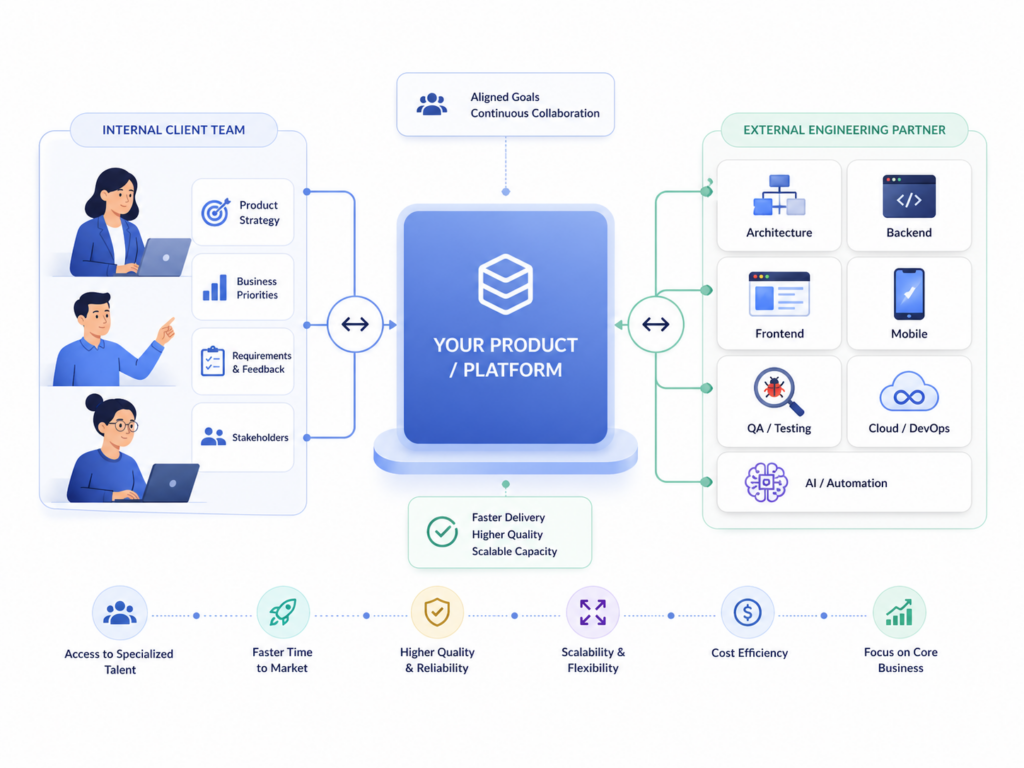
The strongest advantages of outsourcing come from access, flexibility, and delivery structure. A company can move faster, cover more technical areas, and avoid some of the delays that come with building every capability internally from the beginning.
1. Access to experienced engineering talent
Hiring strong software engineers is difficult, especially when a project requires more than one skill set.
A serious product may need frontend developers, backend engineers, mobile developers, DevOps support, QA, product thinking, and sometimes architecture or AI experience. Hiring all of those roles internally can be slow and expensive.
Outsourcing gives companies access to a ready team that already has experience across multiple areas of software development. This is especially useful when the project requires several technical layers working together, such as a web application, mobile app, backend API, database, cloud deployment, and external integrations.
The value is not just having more people available. The value is having people who have already solved similar problems and can help avoid common technical mistakes early.
2. Faster start without a long hiring process
Building an internal development team takes time. Companies need to define roles, find candidates, interview them, negotiate offers, onboard new hires, and wait until the team becomes productive together.
That process can take months, and the outcome is not guaranteed.
Outsourcing can shorten the time between deciding to build and actually making progress. A good external team can review the project, estimate the scope, define technical priorities, and start development without the same delay as a full recruitment cycle.
This does not mean development should be rushed. It means the project can begin with a more complete team from the start.
3. Broader technical coverage
Many software projects fail or slow down because one part of the system is handled well while another part is neglected.
For example, a company may have a good frontend but weak backend architecture. Or a working mobile app but unstable infrastructure. Or a useful product idea but no clear database design, deployment process, or integration strategy.
A strong outsourced software development team can cover multiple parts of the system together:
- product design and user flows
- frontend and web application development
- native or cross-platform mobile development
- backend development and API design
- database architecture
- cloud infrastructure and deployment
- third-party integrations
- AI, automation, search, and analytics features
This broader coverage is one of the main reasons outsourcing can work well for companies building complex software systems.
For example, mile.dev software development services include web, mobile, backend, AI, cloud, architecture, integrations, migrations, and scaling - because real products rarely fit into one narrow technical category.
4. More flexibility as priorities change
Software projects change as they move forward. New information appears. Users react differently than expected. Business priorities shift. Some features become more important, while others can wait.
Outsourcing can give companies more flexibility than a fixed internal team structure.
If the project needs more backend work one month and more mobile development the next, an external team can often adjust more easily than a company that has hired for one narrow role. This is especially useful for startups, growing businesses, and companies modernizing existing systems.
The key is to avoid a rigid fixed-scope mindset. Software development works better when the team can plan clearly, estimate realistically, and adapt without losing control of cost or direction.
5. Lower operational burden
Hiring engineers is not the only cost of building software internally.
Companies also need to manage onboarding, processes, tools, project management, code review, testing, deployment, documentation, and technical decision-making. For a business without an established software department, this can become a major burden.
Outsourcing reduces some of that operational weight.
A reliable development partner should bring not only engineers, but also a working delivery process. That includes communication, task tracking, estimation, technical planning, testing, deployment support, and clear ownership of responsibilities.
This allows the client to stay focused on product direction, business priorities, and decision-making while the engineering team handles execution in a structured way.
6. Access to architecture and technical judgment
One of the most important advantages of outsourcing is often overlooked: good technical judgment.
Many software problems do not come from bad coding alone. They come from weak architecture, unclear data structures, poor integrations, unrealistic estimates, or decisions that only work for the first version of the product.
A good development partner should help answer questions like:
- What should be built first?
- Which features are risky?
- Where will the system need to scale later?
- Which integrations should be isolated?
- What should be automated?
- What technical debt is acceptable, and what is dangerous?
This is especially important for complex systems, SaaS platforms, internal tools, CRM systems, IoT platforms, mobile applications, and products that are expected to evolve over several years.
7. Better long-term support
Software does not end when the first version is launched, and planning how much it costs to build an MVP up front makes those later stages easier to fund.
Most successful products need continuous improvement: new features, bug fixes, infrastructure updates, performance improvements, security upgrades, user feedback, integrations, and ongoing maintenance.
Outsourcing can be useful not only for building a product, but also for maintaining and improving it over time.
This is especially relevant for companies with existing software that has become difficult to maintain. In those cases, an external team can help stabilize the system, improve the architecture, modernize infrastructure, and continue development without requiring the company to rebuild everything from scratch.
Some of the strongest outsourcing partnerships are long-term. The external team becomes deeply familiar with the product, the business logic, the users, and the technical history of the system.
When outsourcing software development works best
Outsourcing is not automatically the right choice for every company. It works best when there is a real need for engineering capacity and enough clarity to begin structured work.
It is usually a good fit when:
- you need to build a new product but do not have a full internal team
- your existing system needs improvement, modernization, or stabilization
- you need technical skills that are not available internally
- you want to move faster without rushing the hiring process
- your project requires multiple disciplines, such as web, mobile, backend, cloud, and integrations
- you need long-term development support, not just a one-off task
It is also a strong option when a company has a clear business goal but needs help translating that goal into a realistic technical plan.
When outsourcing may not be the right choice
Outsourcing is not a shortcut around product thinking, decision-making, or responsibility.
It may not work well when:
- there is no clear decision-maker on the client side
- the budget is not realistic for the desired scope
- the company expects fixed-price certainty for a complex, evolving product
- requirements change constantly without prioritization
- there is no willingness to communicate regularly
- the external team is treated only as a cheap coding resource
The best results come when the client and development team work as partners. The client brings business context and priorities. The engineering team brings technical structure, delivery discipline, and implementation.
How to choose the right outsourcing partner
The quality of the partner matters more than the outsourcing model itself.
A good software development partner should be able to explain how they estimate work, how they manage scope, how they communicate progress, and how they make technical decisions.
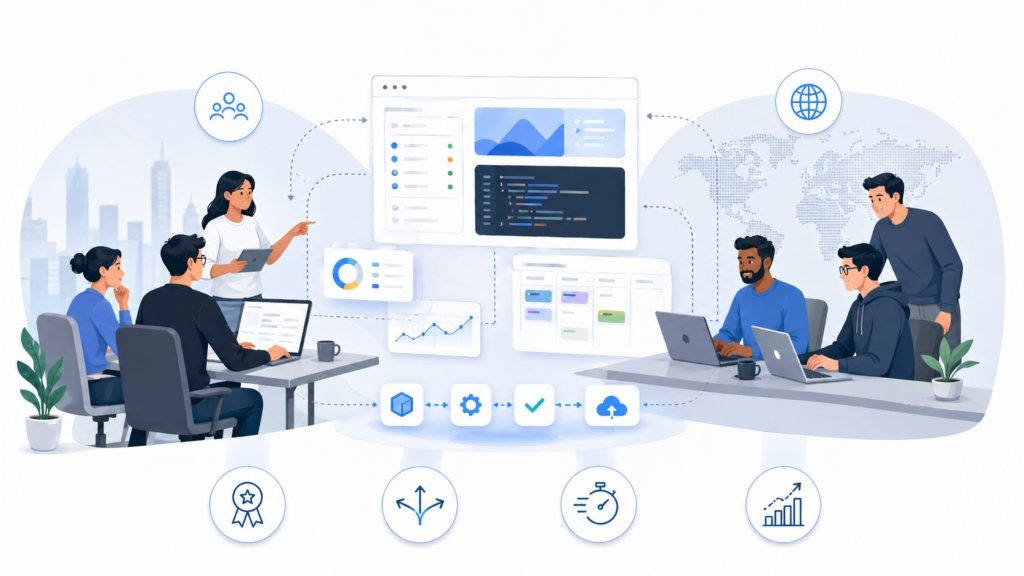
Before choosing a team, look for signs of:
- real architecture experience
- clear estimation process
- transparent communication
- experience with similar systems
- strong backend and infrastructure capability
- ability to work on existing systems, not only new builds
- clear ownership of code, infrastructure, and documentation
- long-term support after launch
Case studies are also useful. They show whether the team has worked on real systems, handled complexity, and stayed involved beyond the first release.
You can see examples of long-term software work on the mile.dev case studies page.
The real advantage is structure
The biggest advantage of outsourcing software development is not simply lower cost.
The real advantage is getting access to a structured engineering team that can help turn a business goal into reliable software.
That means realistic estimation, clear architecture, steady delivery, transparent communication, and the ability to keep improving the system after launch.
Outsourcing works best when it is treated as a serious engineering partnership - not a quick way to buy cheaper development hours.
If you are considering outsourcing software development for a new product, an existing system, or a platform that needs stronger technical direction, you can start with a free consultation. We will review the scope and respond with structured technical feedback.